12. January 2026
Admin
SpaceX Launches NASA’s Pandora Satellite to Study Exoplanet Atmospheres
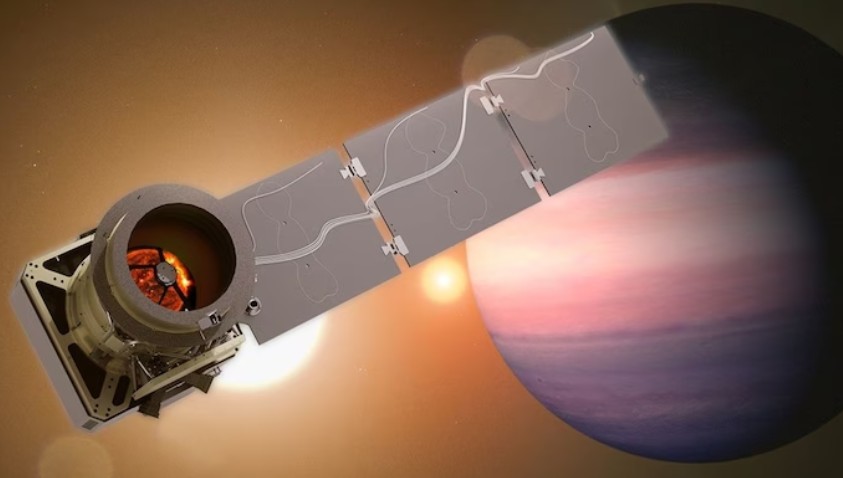
On **January 11, 2026**, SpaceX successfully launched a **Falcon 9 rocket** from **Vandenberg Space Force Base** in California carrying NASA’s **Pandora satellite** along with about 40 other payloads in a rideshare mission called “Twilight.” The Pandora spacecraft is designed to conduct an unprecedented study of the atmospheres of at least 20 known exoplanets — worlds beyond our solar system.
Quick Insight:
The Pandora mission will track how starlight changes as planets pass in front of their host stars (transits), helping scientists distinguish the atmospheric signatures of planets from the effects of their stars. Pandora’s multi-wavelength observations promise new insights into atmospheric composition, clouds, hazes, and potential signs of habitability.
About the Pandora Mission
• Pandora is a **NASA Astrophysics Pioneers mission** equipped with a **17-inch visible and near-infrared telescope**, optimized for long-duration exoplanet transit observations.
• Over the course of its planned **one-year primary mission**, Pandora will repeatedly observe at least 20 exoplanets to analyze their atmospheric properties and better understand how their stars influence observed light.
• The mission will help disentangle planet signals from stellar activity, providing clearer data on atmospheric components like hydrogen, oxygen, and water vapor.
SpaceX Twilight Rideshare Launch
• The Falcon 9 launch carried Pandora alongside about **three dozen other satellites**, including communications spacecraft and Earth-imaging smallsats as part of SpaceX’s growing rideshare program.
• The launch placed all payloads into a **dusk-dawn sun-synchronous orbit**, ideal for consistent solar power and continuous observations.
• This mission continues SpaceX’s trend of frequent and versatile rideshare flights, enabling science and commercial satellites to reach orbit cost-effectively.
Scientific Significance
• Pandora’s simultaneous visible and infrared measurements will allow astronomers to separate stellar variability from true planetary atmospheric signals.
• By observing multiple transits per target, Pandora will build detailed atmospheric profiles that can guide future missions and telescopes, including the **James Webb Space Telescope** and others focused on habitability studies.
• The data gathered could help identify planets with atmospheres rich in water vapor or other key molecules, advancing the search for life beyond Earth.
Final Thoughts
The successful launch of NASA’s Pandora satellite marks an exciting step forward in exoplanet research, combining advanced observation technology with cost-efficient rideshare launch capabilities from SpaceX. As Pandora begins its mission in orbit, scientists expect a wealth of new data that will deepen our understanding of alien worlds and the nature of planetary atmospheres across the galaxy.