14. December 2025
Admin
Ultra-Small Optical Chip Uses 80× Less Power, Paving the Way for Scalable Quantum Computers
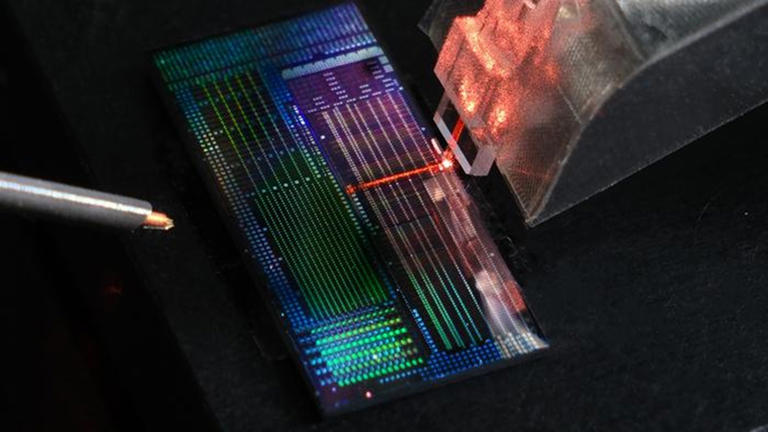
Scientists have developed a **new optical chip component** that is nearly 100 times thinner than a human hair and uses about **80 times less energy** than conventional systems. This breakthrough could significantly reduce power consumption and heat generation, helping advance the long-sought goal of building huge, scalable quantum computers.
Quick Insight:
One of the biggest barriers to large-scale quantum computing has been the size, heat, and power demands of optical control systems. By shrinking these components and making them energy-efficient, researchers have moved closer to packing thousands — or even millions — of qubits onto future quantum machines.
1. What Makes the Chip Special
• The device is built using scalable semiconductor manufacturing methods — similar to those used for everyday computer processors — enabling the potential for mass production.
• It precisely controls laser light frequencies with much less power, making it ideal for delicate quantum operations.
• Lower power needs mean less heat and the ability to place many devices densely on a single chip.
2. Why This Matters for Quantum Machines
• Quantum computers often use lasers to manipulate qubits, and scaling that control to thousands of qubits demands tiny, efficient components.
• Traditional optical systems are bulky and energy-intensive, making them impractical for large machines.
• This new approach helps reduce reliance on large lab setups and moves control electronics onto compact chips.
3. What This Could Enable
• With more efficient optical devices, future quantum computers could be **far more compact and energy efficient** — a key requirement for moving beyond small laboratory prototypes.
• Denser integration could help quantum computing become practical for real-world applications such as optimization, cryptography, materials science, and machine learning.
• The technology also opens the door to on-chip quantum networking and other photonic systems beyond computing alone.
">
Final Thoughts
Reducing the size and energy consumption of optical components is a major step toward making large-scale quantum computers real. By combining photonic elements with standard chip fabrication techniques and cutting energy use, researchers are clearing the path for quantum devices that are both **power efficient and scalable** — bringing us closer to the next generation of computing.
Tip: Optical and photonic chips are emerging as a promising route to ultra-efficient computing — both for quantum and future AI systems — because light can carry information with low power and high speed.











































.jpg)