New Study Offers Evidence That Black Holes Behave Like Quantum Systems
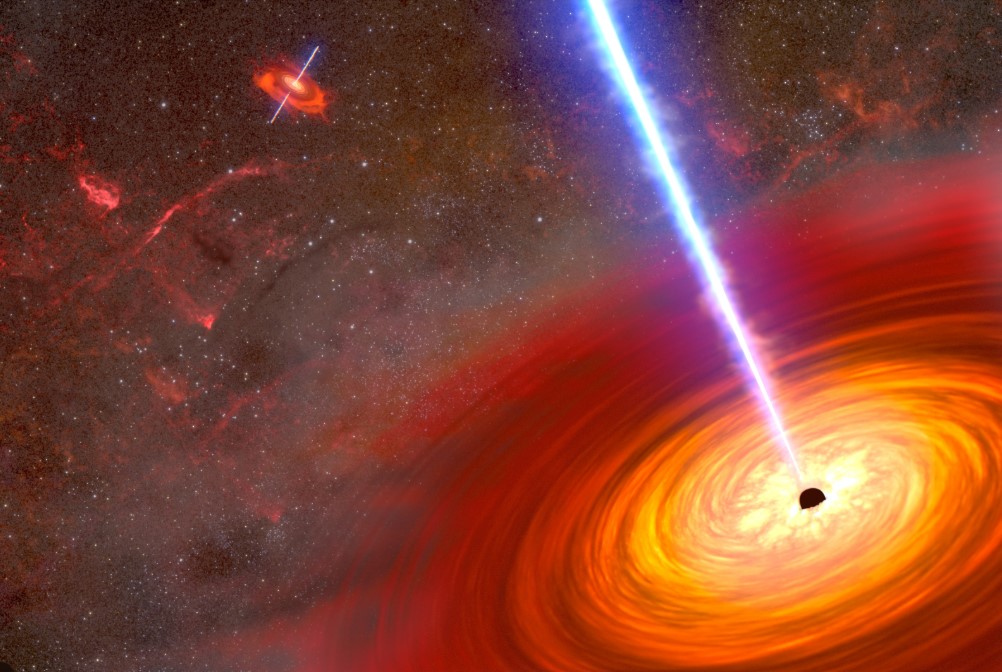
Recent theoretical research suggests that black holes — long seen as mysterious cosmic objects — may follow quantum rules just like the tiniest particles. By carefully examining black‑hole entropy at extremely low temperatures, physicists find that entropy stays non‑negative and tends to zero, indicating black holes possess a unique “ground state,” similar to ordinary quantum systems.
Quick Insight:
If black holes have isolated ground states and behave like quantum systems, this could be a major step toward uniting gravity with quantum mechanics — potentially unlocking secrets about how the universe works at its deepest level.
1. What the Study Did
• The researchers addressed long‑standing puzzles about black‑hole entropy at low temperature, where earlier calculations sometimes predicted unphysical (negative) entropy values.
• Using a refined method — focusing on “sem i‑quenched entropy” rather than simpler averaging procedures — they showed entropy remains positive and smoothly goes to zero as temperature approaches absolute zero.
• This behavior mirrors that of typical quantum systems with a unique lowest‑energy state (“ground state”), hinting strongly that black holes follow quantum‑mechanical rules.
2. Why It Matters for Quantum Gravity
• One of the biggest challenges in modern physics is reconciling gravity (described by general relativity) with quantum mechanics — this result suggests black holes might bridge the gap.
• If black holes truly have quantized ground states, their formation, evaporation, and internal structure may follow quantum laws — offering a pathway to a “quantum theory of gravity.”
• This could reshape how we think about space, time, and the fate of information swallowed by black holes.
3. What This Means for Future Research
• Physicists may extend these calculations beyond simplified models to more realistic, higher‑dimensional black holes — bringing theory closer to what we observe in the universe.
• The findings may influence how we study phenomena like black‑hole evaporation, Hawking radiation, and the so‑called “information paradox.”
• Ultimately, this could help lead to a fully consistent quantum‑gravity framework — changing our foundational understanding of the cosmos.
Final Thoughts
The idea that black holes might behave like quantum systems isn’t just theoretical win — it’s a sign that the universe’s most extreme objects could hold clues to the deepest laws of nature. As scientists push these findings further, we may finally get closer to answering fundamental questions: How does gravity work at the smallest scales — and what really happens inside a black hole?
Tip: Keep an eye on developments in theoretical physics — upcoming papers may expand these findings to more realistic black‑hole models, and possibly lead to testable predictions.