Trump Weighs AI Partnership Model as Debate Grows Over Public Ownership of OpenAI, Anthropic and xAI
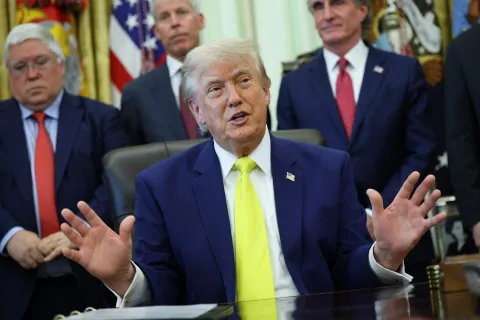
A growing debate in Washington is raising questions about who should benefit from the massive economic gains expected from artificial intelligence. The discussion intensified after U.S. President Donald Trump signaled openness to exploring a model in which the American public could gain a stake in leading AI companies such as OpenAI, Anthropic, and xAI.
Key Update: President Trump said his administration would examine the possibility of creating a partnership between the American public and major AI companies. The discussion follows proposals from Senator Bernie Sanders, who has argued that Americans should directly share in the wealth generated by artificial intelligence.
The Idea Behind Public Ownership of AI
The proposal centers on a simple question: if artificial intelligence transforms the global economy and generates enormous wealth, should ordinary citizens share in the financial benefits?
Supporters argue that AI systems are built using knowledge, information, research, and creative works produced by society over many decades. They believe the public should therefore receive some form of ownership or economic participation in the industry's future growth.
Trump's Response to the Proposal
Speaking to reporters, President Trump said his administration is looking into the concept of AI companies giving the American public a stake in their businesses.
According to reports, preliminary discussions have already taken place between government officials and major AI firms. Trump described the concept as potentially becoming a new type of partnership between AI developers and the American people.
Bernie Sanders' AI Sovereign Wealth Fund Proposal
Senator Bernie Sanders has emerged as one of the strongest advocates for public participation in AI-generated wealth.
He has proposed creating an American AI Sovereign Wealth Fund that would hold ownership stakes in major AI companies. Sanders argues that because AI systems draw heavily on humanity's collective knowledge and creative output, the resulting wealth should not be concentrated solely among technology executives and investors.
Why the Debate Is Gaining Momentum
Artificial intelligence is increasingly viewed as a technology comparable to electricity, the internet, or the industrial revolution in terms of its potential impact on society.
Many policymakers worry that AI could dramatically increase productivity and corporate profits while also disrupting jobs and concentrating wealth among a small number of companies. These concerns have led to growing discussions about how the benefits of AI should be distributed.
OpenAI and Sam Altman's Role
Reports indicate that OpenAI CEO Sam Altman has previously expressed support for concepts that allow broader public participation in AI-driven economic growth.
The idea of public wealth funds linked to AI has been discussed by various policymakers and industry leaders as a possible mechanism for ensuring that the gains from automation and artificial intelligence benefit society more broadly.
How Government Involvement Could Work
Several approaches have been suggested.
Some proposals involve voluntary share contributions from AI companies into a public fund. Others envision government investment programs that acquire ownership stakes in strategically important technology firms.
No final framework has been announced, and discussions remain in the exploratory stage. Officials have emphasized that no formal agreements have yet been reached.
Supporters See a Historic Opportunity
Advocates argue that a public ownership model could help ensure that AI-generated wealth benefits society at large rather than a small group of investors.
They often point to successful sovereign wealth funds in places such as Norway and Alaska as examples of how national wealth can be shared among citizens through long-term investment structures.
Critics Warn About Government Influence
Not everyone supports the idea.
Critics argue that government ownership in major AI firms could create conflicts of interest, reduce competition, or lead to excessive political influence over private companies.
Others worry that such arrangements could discourage innovation if companies become too closely tied to government objectives.
The Debate Comes During Rapid AI Expansion
The discussion arrives as governments worldwide are racing to develop policies for artificial intelligence.
Recent U.S. initiatives have included cybersecurity reviews of advanced AI systems, national security directives, and discussions about how to balance innovation, competitiveness, and safety as AI capabilities continue to expand.
Final Thoughts
The emerging debate over public ownership of AI companies reflects a larger question about the future of the global economy: who should benefit from one of the most powerful technologies ever created?
While no concrete plan has yet been implemented, the fact that leaders from across the political spectrum are discussing public participation in AI wealth demonstrates how significant artificial intelligence has become to economic and national policy. Whether through sovereign wealth funds, public-private partnerships, or other mechanisms, the conversation is likely to intensify as AI companies continue to grow in value and influence.
AI Insight: Discussions about public ownership of AI companies remain at an early stage, but they highlight growing concerns about how the enormous economic value created by artificial intelligence should be distributed in the future.
















.jpeg)