Peter Thiel Says AI May Threaten Technical Jobs More Than Creative Careers
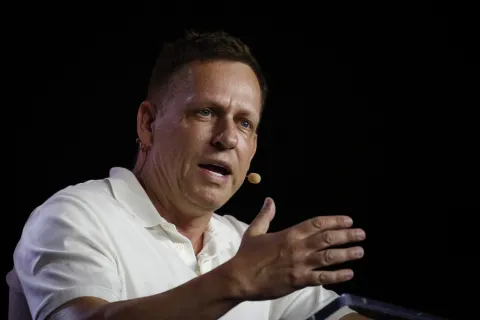
Billionaire investor and Palantir co-founder Peter Thiel has sparked debate by arguing that artificial intelligence may pose a greater threat to highly technical jobs than to careers built around communication, creativity, and human judgment.
His comments challenge a long-standing belief that STEM careers would remain the safest path in an increasingly automated economy. Instead, Thiel suggests that AI could automate many technical tasks faster than people expect, while creative thinking and storytelling may become even more valuable in the years ahead.
Key Update: Peter Thiel argued that AI appears to be affecting "math people" more than "word people," pointing to a future where communication, creativity, judgment, and storytelling could become increasingly important skills in the labor market.
Why Thiel's Comments Are Generating Attention
For years, students were encouraged to pursue science, technology, engineering, and mathematics fields because they were seen as stable, high-paying, and resistant to automation.
However, advances in artificial intelligence are beginning to challenge that assumption. AI systems can now generate code, analyze data, automate research tasks, and perform work that once required specialized technical training.
Thiel believes this trend could reduce the advantage traditionally associated with certain technical skill sets.
"Math People" Versus "Word People"
During a resurfaced interview originally recorded in 2024, Thiel suggested that AI may impact technical professions more heavily than careers centered on language and communication.
He argued that AI is becoming increasingly capable of handling mathematical and analytical tasks, while human-centered abilities such as communication, persuasion, interpretation, and storytelling remain difficult to automate completely. The comments quickly attracted attention because they challenge traditional assumptions about which skills are most future-proof.
Communication Skills Are Becoming More Valuable
Recent labor market research appears to support parts of Thiel's argument.
LinkedIn's Skills on the Rise report found growing demand for:
• Communication skills
• Leadership abilities
• People management
• Creative thinking
• Strategic decision-making
• Storytelling and content creation
LinkedIn also reported a significant increase in job postings seeking candidates with strong storytelling abilities and communication expertise.
AI Is Changing Technical Work
The rise of AI does not necessarily mean technical careers are disappearing. Instead, many experts believe technical work is evolving.
AI tools can now assist with:
• Writing software code
• Data analysis
• Research tasks
• Documentation
• Testing and debugging
• Technical problem-solving
As a result, workers increasingly need to combine technical knowledge with creativity, judgment, and the ability to work effectively alongside AI systems.
New AI-Related Skills Are Emerging
While some traditional technical tasks may become more automated, entirely new skill categories are appearing.
Growing areas include:
• AI prompt engineering
• AI system training
• Data annotation
• AI product management
• Human-AI collaboration
• AI ethics and governance
Many of these roles require both technical understanding and strong communication skills, blending traditionally separate disciplines.
Labor Market Trends Are Sending Mixed Signals
The employment picture remains complex.
Some technical fields continue to show strong demand, particularly in engineering, infrastructure, and advanced manufacturing. However, certain technology-related sectors have experienced hiring slowdowns and workforce reductions as companies increase their use of AI tools. At the same time, businesses continue searching for workers who can think critically, communicate clearly, and solve problems creatively.
Critical Thinking May Matter More Than Ever
Many executives increasingly view critical thinking as one of the most important skills in the AI era.
As AI systems become more powerful, organizations still need people who can:
• Evaluate AI-generated outputs
• Make strategic decisions
• Understand human needs
• Lead teams
• Navigate uncertainty
• Exercise judgment and responsibility
Several recent business surveys have highlighted concerns that companies may face shortages of workers with strong critical-thinking and decision-making abilities.
The Debate Over AI and Employment Continues
Not everyone agrees with Thiel's perspective.
Some analysts argue that AI will transform nearly every profession rather than targeting one category of workers. Others believe technical expertise will remain essential because AI systems themselves require development, oversight, and continuous improvement.
Industry discussions increasingly focus on adaptation rather than replacement, with experts encouraging workers to combine technical knowledge with broader human-centered skills.
What Students and Workers Can Learn
The broader lesson from the debate may not be that technical skills are becoming unimportant.
Instead, many experts suggest future success may depend on combining:
• Technical literacy
• Communication skills
• Creativity
• Problem-solving ability
• Adaptability
• Emotional intelligence
Workers who can bridge both technical and human-centered disciplines may be particularly valuable as AI continues reshaping industries.
Final Thoughts
Peter Thiel's argument that AI may threaten technical jobs more than creative careers has reignited discussion about the future of work. While STEM skills remain valuable, the rapid advancement of AI is changing which abilities employers prioritize and how work gets done.
Rather than creating a world where technical knowledge becomes irrelevant, AI appears to be increasing the importance of combining technical expertise with communication, creativity, judgment, and critical thinking. As businesses adapt to new technologies, workers who can effectively blend both sides may be best positioned for long-term success in an AI-driven economy.
Tech Insight: AI is increasingly automating routine technical tasks, but demand for communication, creativity, leadership, judgment, and storytelling continues to rise. Many experts believe the most valuable future workers will combine technical understanding with uniquely human skills.